Phone/whatsapp:+86177-2151-9382
Physical address:
Yangshanfan Road Intersection, Chengdong Village, Hengcun Town, Tonglu County, Hangzhou City, Zhejiang. China
Email address:
Quote@weaveessence.com
Triangle Scarf Manufacturer — China Factory Direct
Custom Triangle Scarves — Bandana, Neckerchief & Pet Bandana OEM, 500 pcs MOQ
Factory-direct custom triangle scarves for fashion brands, promotional buyers and pet accessory retailers. Cotton, polyester satin and woven jacquard from 500 pcs MOQ. OEKO-TEX certified. ISO 105-C06 Grade 4–5 wash fastness. Sample in 10–15 days.

500 pcs
MOQ per design colourway
Grade 4–5
Wash fastness ISO 105-C06
10–15 Days
Sample lead time
5 Hem Types
Hand-rolled to merrow border
OEKO-TEX
Standard 100 certified
What Triangle Scarf Manufacturing Actually Involves
Triangle scarves are deceptively straightforward in appearance. A square of fabric, folded diagonally — and yet the commercial outcome of a triangle scarf manufacturer programme hinges on a set of production decisions that most buyers do not encounter until something goes wrong. WeaveEssence produces custom bandanas, neckerchiefs, kerchiefs and pet bandanas for fashion brands, promotional merchandise buyers and pet accessory retailers across the US, UK, EU and Australia, factory direct from China.
The three production variables that determine whether a triangle scarf succeeds or fails in the market are: fabric selection (which governs drape, print quality and perceived value), dye method (which determines wash fastness and whether the colour survives commercial laundering), and hem construction (which affects drape, durability and price positioning). Get all three right and the product sells. Get any one wrong and it generates returns. We specify all three in writing in our pre-production documentation before any sample is approved.
Our production covers the full range of triangle scarf formats — from 50×50 cm promotional bandanas to 90×90 cm fashion neckerchiefs — with decoration options including screen printing with reactive dyes, dye sublimation, digital textile printing and woven jacquard construction. OEKO-TEX Standard 100 certification is available across all product types, as is REACH compliance documentation for EU-market orders.
“Choosing the wrong dye method for a fabric is not a minor quality issue — it is a structural product defect that no finishing treatment can correct after the fact. We specify dye method and fabric together, not separately.”
Factory Note
Print Methods
Screen / Sublimation / Digital / Jacquard
Fabric Range
Cotton · Poly Satin · Poly Twill · Cotton-Poly
Wash Fastness
ISO 105-C06 Grade 4–5
Sizes (Human)
50×50 cm – 90×90 cm
Sizes (Pet)
25×25 cm – 45×45 cm
Hem Options
5 types — machine-rolled to merrow
Certifications
OEKO-TEX Std 100 / BSCI / REACH
Bulk Lead Time
35–45 working days from PO
Three Misconceptions That Produce Defective Triangle Scarves
❌ Misconception: “Triangle scarves are just printed fabric — any supplier can produce them to the same standard.”
✔ Reality: The difference between a professional triangle scarf and a cheap bandana is entirely in the production decisions, not the product category.
Screen-printed cotton with heat-set reactive dyes achieves ISO 105-C06 wash fastness Grade 4–5. An uncontrolled pigment print on non-scoured fabric achieves Grade 2–3 — visible colour loss after 5–10 washes. Hem quality determines how the scarf drapes and holds its shape over time. These are not cosmetic differences. They determine return rates, repeat orders and brand perception, and they are entirely within the control of the manufacturer.
❌ Misconception: “Dye sublimation on polyester and reactive printing on cotton produce equivalent results — you can substitute one for the other.”
✔ Reality: Sublimation and reactive dye are chemically incompatible processes and cannot be interchanged by fabric type.
Dye sublimation converts disperse dye from solid to gas phase under heat (~200°C), bonding permanently to the polyester polymer chain. This process does not work on natural fibres: cotton has no polymer chain to accept the disperse dye molecule. Reactive dye forms a covalent bond with cellulose and is the correct chemistry for cotton. A supplier offering sublimation on cotton is describing an impossible process — or using pigment and misidentifying it. Practical consequence: Grade 2–3 wash fastness at best.
❌ Misconception: “Pet bandanas are just small bandanas — any fabric and dye will work.”
✔ Reality: Pet bandanas require OEKO-TEX certified dyes because animals lick and chew fabrics, creating a direct ingestion risk that human textile products do not carry.
OEKO-TEX Standard 100 tests for over 100 harmful substances including restricted azo dyes, formaldehyde, heavy metals and pesticide residues. A non-certified dye may comply with human textile regulations and still contain substances harmful to animals. We produce pet bandanas exclusively with OEKO-TEX certified cotton and certified dyes — the baseline standard, not a premium feature.
Triangle Scarf Product Types — Four Core Formats
Each product format has distinct fabric, dye method and hem requirements. The correct format depends on end use, brand positioning and washing frequency. We confirm the right specification in writing before the first sample is produced.
01 — Standard Bandana & Kerchief
Printed Cotton Triangle Scarves
Cotton is the benchmark fabric for printed bandanas and kerchiefs. It accepts reactive dye with a covalent fibre bond, producing ISO 105-C06 Grade 4–5 wash fastness that survives commercial laundering. Standard weights run 100–140 GSM for bandanas and 140–180 GSM for heavier kerchiefs.
Hem options include machine-rolled (consistent, cost-efficient), hand-rolled (narrow, fluid drape) and overlocked (durable, casual). Screen printing with heat-set reactive dyes is standard; digital reactive printing available for photographic artwork or small runs.
100–180 GSM
Reactive dye Grade 4–5
MOQ 500 pcs
02 — Fashion & Luxury
Polyester Satin Triangle Scarves
Polyester satin provides a high-lustre, silk-like surface at a fraction of the cost of natural silk. Dye sublimation printing achieves photographic-quality full-colour design with Grade 4–5 wash fastness and excellent light fastness (ISO 105-B02 Grade 4–5). The fabric drapes fluidly and photographs well — important for e-commerce and social media positioning.
Weights typically run 75–120 GSM. Hand-rolled hems are standard for premium positioning. Custom dimensions up to 140 cm print width.
75–120 GSM
Sublimation Grade 4–5
MOQ 500 pcs
03 — Structural Pattern
Woven Jacquard Triangle Scarves
Woven jacquard construction integrates the pattern directly into the fabric structure during weaving. The design cannot fade, crack or peel because there is no applied surface layer — the pattern is the fabric. This format suits heritage brands, luxury accessories and corporate gifting where perceived quality and longevity across many wash cycles are priorities.
Produced in cotton, cotton-silk blends or fine polyester at 120–200 GSM. Multi-colour designs require no additional print cost beyond the initial programme fee.
120–200 GSM
No wash-fastness limit
MOQ 500 pcs
04 — Dog & Cat Accessories
Pet Bandanas
Pet bandanas in 25×25 cm to 45×45 cm, produced in OEKO-TEX certified cotton and certified dyes. OEKO-TEX Standard 100 certification addresses both skin safety and ingestion risk — critical for products that animals lick and chew. Fastening options include tie-on, snap-button and slide-through collar designs.
Screen printing and digital printing are both available. All pet bandana fabrics are tested against restricted azo dyes, formaldehyde and heavy metals before production approval.
25–45 cm sizes
OEKO-TEX certified dyes
MOQ 500 pcs
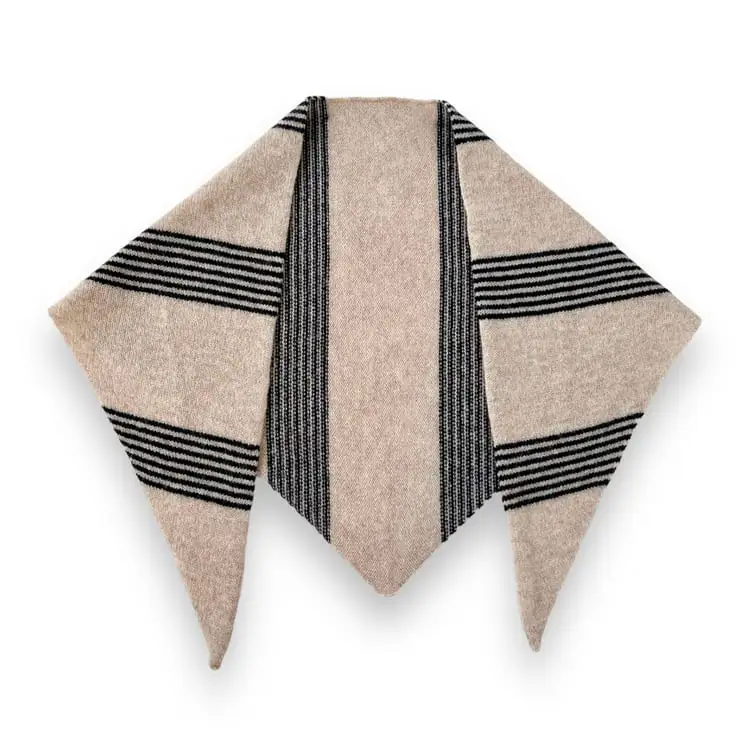
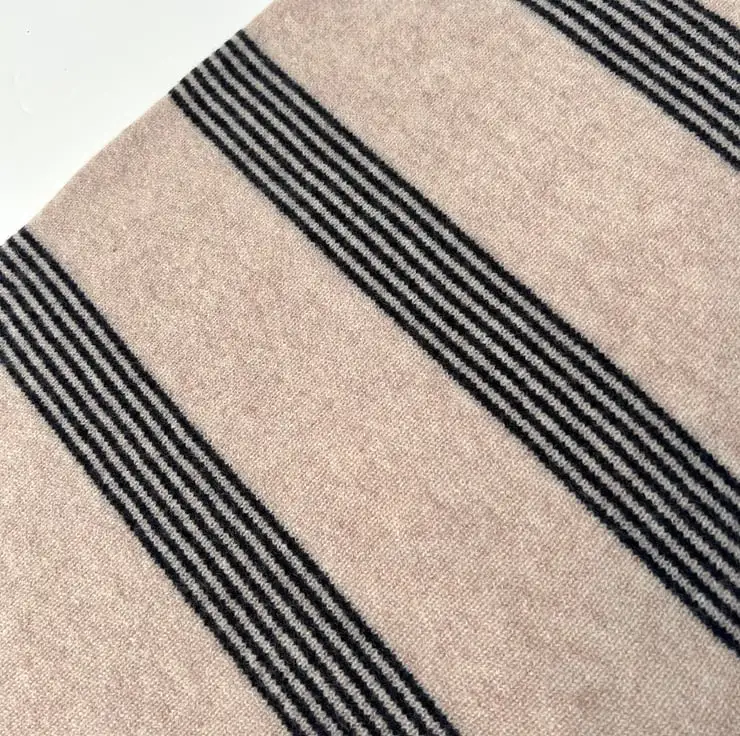
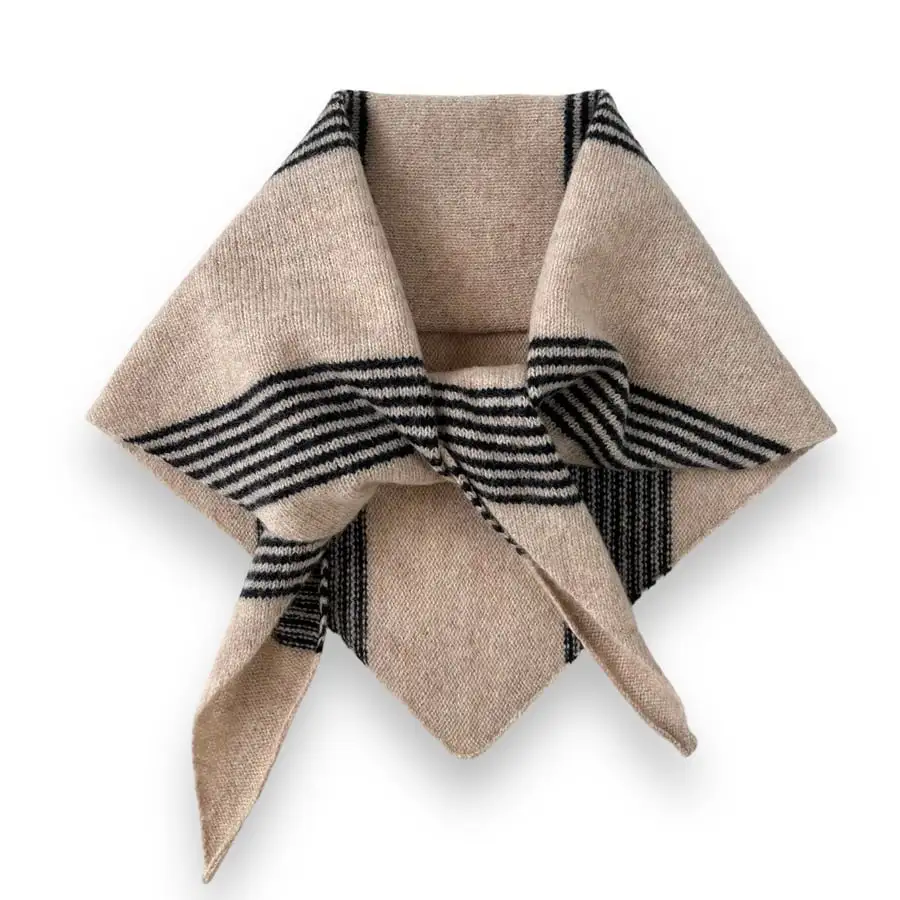
Fabric Comparison — Four Main Materials for Triangle Scarves
Fabric choice is the single most consequential decision in triangle scarf production: it determines which print method is correct, what wash fastness is achievable, and what price tier the product occupies.
| Property | Cotton | Polyester Satin | Polyester Twill | Cotton-Polyester Blend |
|---|---|---|---|---|
| Weight (GSM) | 100–180 GSM | 75–120 GSM | 90–150 GSM | 110–160 GSM |
| Correct print method | Reactive dye / screen / digital | Dye sublimation only | Dye sublimation / screen | Screen (pigment) / digital |
| Wash fastness (ISO 105-C06) | Grade 4–5 (reactive dye) | Grade 4–5 (sublimation) | Grade 4–5 (sublimation) | Grade 3–4 (pigment) |
| Drape | Soft, natural | Fluid, lustrous | Structured, matte | Moderate, versatile |
| Surface texture | Matte, natural | Smooth, high sheen | Diagonal weave, matte | Matte, slight texture |
| OEKO-TEX available | Yes | Yes | Yes | Yes |
| Price tier | Mid | Mid–High | Low–Mid | Low–Mid |
| Best for | Bandanas, kerchiefs, pet bandanas | Fashion, luxury gifting | Promotional, sports, outdoor | Promotional, uniform, budget |
Wash fastness tested per ISO 105-C06. Pigment print on cotton-polyester blend achieves Grade 3–4 only; reactive dye cannot bond to the polyester component. All fabrics available with OEKO-TEX Standard 100 certification.
Production Specification Overview
Full production parameters for custom triangle scarves, bandanas and neckerchiefs. Specifications outside these ranges are available on request; all deviations confirmed in writing before sample production.
MOQ
500 pcs
Per design colourway
Wash Fastness
Grade 4–5
ISO 105-C06 (reactive / sublimation)
Sample Lead Time
10–15 days
From artwork approval
Bulk Lead Time
35–45 days
From PO + deposit
| Parameter | Specification |
|---|---|
| MOQ | 500 pcs per design colourway |
| Construction | Woven cut & hem; woven jacquard; printed square (bandana format) |
| Size range (human) | 50×50 cm to 90×90 cm square, folded diagonally; custom dimensions available |
| Size range (pet bandana) | 25×25 cm to 45×45 cm; snap-button, tie-on and collar-slide styles |
| Weight range | 75–200 GSM depending on fabric and construction |
| Decoration methods | Screen printing (reactive dye), dye sublimation, digital textile printing, woven jacquard |
| Wash fastness | ISO 105-C06 Grade 4–5 (reactive / sublimation); Grade 3–4 (pigment); tested per batch |
| Light fastness | ISO 105-B02 Grade 4–5 (sublimation on polyester) |
| Hem options | Machine-rolled, hand-rolled, overlocked, merrow border, raw edge |
| Certifications | OEKO-TEX Standard 100; BSCI; REACH compliance (EU orders); SGS/Intertek on request |
| Packaging | Polybag, header card, hang tag, custom retail box, tissue wrap; private label available |
| Sample lead time | 10–15 working days from artwork approval |
| Bulk lead time | 35–45 working days from PO and deposit confirmation |
| QC standard | AQL 2.5 inline + pre-shipment inspection per ISO 2859-1 |
OEM Process for Triangle Scarves — Five Steps from Brief to Shipment
Triangle scarf OEM is faster than knitted or woven scarf production because there is no yarn dyeing or knit programme development step for printed constructions. The critical path is artwork approval and dye strike-off sign-off — both requiring buyer input. See our full sampling and lead-time guide for a detailed breakdown by construction type.
01
Brief & Artwork Submission
Days 1–2
Buyer provides artwork file (vector AI/EPS or 300 dpi raster), fabric specification, size, quantity and packaging requirements. We confirm feasibility and quote within 2 working days. Strike-off fabric and dye method confirmed in writing at this stage.
02
Strike-Off (Print Test)
Days 3–8
Print strike-off produced on the specified production fabric. Colour checked against Pantone reference; wash fastness test run on strike-off sample. Written approval required before bulk production — this is a mandatory hold point.
03
Sample Production & Dispatch
Days 9–18
Full sample produced with approved strike-off, hemmed and finished per specification. Photographed and dispatched to buyer. Amendments incorporated in a revised sample at no charge.
04
Sample Approval & PO
Days 19–22
Written sample approval, Purchase Order and deposit (typically 30–50%) received. Packaging materials ordered in parallel with bulk production scheduling.
05
Bulk Production, AQL & Shipment
Days 23–58
Bulk printing, cutting and hemming. AQL 2.5 pre-shipment inspection. Test report issued. Packed per agreed spec; shipping documents prepared and dispatched with balance payment release.
—
Total: Brief to Port Loading
~8–10 Weeks (printed constructions)
Woven jacquard triangle scarves add 1–2 weeks for programme development. Timelines assume prompt buyer response at each hold point — delays at strike-off or sample approval stage extend the schedule proportionally.
Who Orders Custom Triangle Scarves — Four Buyer Profiles
Triangle scarf buyers come from three distinct markets with different quality expectations, compliance requirements and pricing sensitivities. Identifying the correct profile at enquiry stage allows us to quote the right specification from the start.
Buyer Profile — Fashion
Fashion & Lifestyle Brands
Developing seasonal accessory ranges where the scarf is a brand statement, not a commodity. Primary concern: fabric handle, drape, print accuracy and product uniqueness. Typically require private label packaging, hang tags and care labels compliant with destination market regulations.
Recommended: Polyester satin (75–100 GSM) with dye sublimation, or fine cotton (120–140 GSM) with reactive screen print. Hand-rolled hem. Custom retail box with tissue wrap and branded hang tag. OEKO-TEX Standard 100 and REACH documentation for EU brands.
Buyer Profile — Promotional
Promotional Merchandise Buyers & Distributors
Sourcing branded bandanas for trade show giveaways, event merchandise and corporate campaign kits. Primary concern: consistent colour matching to brand guidelines, reliable lead time and competitive per-unit cost at 500–5,000 pcs volumes.
Recommended: Cotton (100–130 GSM) or cotton-polyester blend with screen printing (1–4 colours). Machine-rolled or overlocked hem. Polybag with header card. See our promotions & gifting supply page for volume programme details.
Buyer Profile — Pet Retail
Pet Accessory Brands & Retailers
Producing dog and cat bandanas for pet shops, online stores and veterinary retail. Primary concern: material safety (OEKO-TEX certified dyes), correct sizing across breed groups and fastening reliability. Growing category with strong repeat-order patterns as seasonal colourways rotate.
Recommended: OEKO-TEX certified cotton (100–130 GSM) with reactive or digital print. Tie-on, snap-button or collar-slide fastening. Retail polybag with hang tag. Full OEKO-TEX documentation with every shipment.
Buyer Profile — Heritage & Luxury
Heritage & Luxury Accessory Brands
Producing signature pattern neckerchiefs where the design is a brand asset requiring exact reproduction across seasons. Primary concern: pattern accuracy, colour consistency season-to-season, and product quality that justifies a premium retail price.
Recommended: Woven jacquard in cotton-silk blend or fine polyester (120–200 GSM). Pattern programme developed from brand artwork and retained for repeat orders. Hand-rolled hem. Year-on-year dye lot reference retained for colour continuity. Details at our private label scarf manufacturing page.
Key Terms for Triangle Scarf Buyers
Technical vocabulary used in triangle scarf and bandana sourcing. Understanding these terms allows buyers to specify correctly and evaluate supplier quotes accurately.
Reactive Dye Printing
A dyeing process in which the dye molecule forms a covalent bond with the cellulose fibre (cotton). This chemical bond produces wash fastness Grade 4–5 (ISO 105-C06) — significantly superior to pigment printing, which sits on the fibre surface and achieves Grade 2–3. Reactive dye works only on natural fibres; it cannot bond to polyester.
Dye Sublimation
A printing process in which disperse dye is converted from solid to gas phase under heat (~200°C) and bonds permanently to polyester polymer chains. Produces photographic-quality designs with Grade 4–5 wash fastness and Grade 4–5 light fastness. Does not work on natural fibres — sublimation on cotton is technically impossible with disperse dye chemistry.
Strike-Off
A small test print run produced on the specified production fabric before bulk manufacturing begins. Used to verify colour accuracy (Pantone match), design registration and wash fastness. Written buyer approval of the strike-off is a mandatory hold point in our process.
Wash Fastness (ISO 105-C06)
The resistance of a printed or dyed fabric to colour change or transfer under washing conditions. Measured on the ISO Grey Scale from Grade 1 (severe colour loss) to Grade 5 (no change). Grade 4–5 is the accepted commercial standard for fashion and promotional scarves.
GSM
Grams per square metre — the standard measure of fabric weight. Lower GSM (75–100) produces lighter, more fluid scarves; higher GSM (150–200) produces heavier, more structured products. GSM directly affects drape, print quality and perceived value at retail.
Hem Construction
The method used to finish the cut edges of a triangle scarf. Hand-rolled hems (narrow, fluid, premium) differ materially from machine-rolled (consistent, cost-efficient), overlocked (durable, casual), merrow border (decorative) and raw edge (fashion-intentional). Hem choice affects drape, durability and price positioning.
Questions Buyers Ask Most
What is the MOQ for custom triangle scarves?
500 pcs per design colourway. This applies to all constructions — printed cotton, polyester satin and woven jacquard. Multiple colourways can ship together but each requires its own 500-pcs minimum.
What print methods are available?
Screen printing with reactive dyes (cotton, Grade 4–5), dye sublimation (polyester, Grade 4–5), digital textile printing (all fabrics), and woven jacquard (structural, no wash-fastness limitation). The correct method depends on fabric type — the fabric comparison table above explains the distinctions.
What wash fastness do printed triangle scarves achieve?
Reactive dye on cotton and sublimation on polyester both achieve ISO 105-C06 Grade 4–5. Pigment print achieves Grade 3–4 only — we specify wash fastness in writing for every construction before sampling begins.
Do you produce pet bandanas with OEKO-TEX certified dyes?
Yes. All pet bandanas use OEKO-TEX certified cotton and certified dyes — this is the baseline standard for animal contact products, not an optional upgrade. Full certification documentation is included with every shipment.
Can you produce OEKO-TEX certified triangle scarves for EU buyers?
Yes. OEKO-TEX Standard 100 is available across all constructions — cotton, polyester satin, polyester twill and woven jacquard. REACH compliance declarations and EU Textile Regulation fibre labels are included as standard for EU-market orders. SGS or Intertek third-party testing can be arranged on request at the buyer’s cost.
Related Pages
Developing Your Triangle Scarf or Bandana Programme?
Share your brief — fabric, size, print method, quantity — and we confirm feasibility within 2 working days. Samples dispatched in 10–15 days.
- MOQ 500 pcs per design colourway
- Sample in 10–15 working days from artwork approval
- ISO 105-C06 Grade 4–5 wash fastness guaranteed
- OEKO-TEX Standard 100 — all fabrics and dyes
- AQL 2.5 QC inspection every batch
- REACH compliance documentation for EU orders
- Pet bandana OEKO-TEX certified dyes as standard
- Factory direct — no trading company layer