Phone/whatsapp:+86177-2151-9382
Physical address:
Yangshanfan Road Intersection, Chengdong Village, Hengcun Town, Tonglu County, Hangzhou City, Zhejiang. China
Email address:
Quote@weaveessence.com
Merino Wool Scarf Manufacturer China – OEM Merino Scarves
Merino Wool Scarf Manufacturer for OEM Bulk Production
17.5–19.5μm fine merino confirmed by AWTA batch test. 100% merino, merino-nylon and merino-cashmere blends. Jacquard woven, plain woven and knitted 7–14gg. OEKO-TEX Standard 100 certified. Mulesing-free documentation available.

Why Merino Is the B2B Sweet Spot Between Natural Luxury and Commercial Viability
Merino fibre is graded in microns — the single measurement that determines perceived softness, itch threshold, landed cost positioning and care requirements. Industry convention classifies merino as superfine (≤17.5μm), fine (17.5–19μm) and medium (19–21.5μm). WeaveEssence’s standard specification sits at 17.5–19.5μm — precisely at and just above the fine-grade boundary. This range falls below the 20-micron itch threshold at which most adults perceive prickle sensation next to skin. Our comfort factor specification requires ≤5% of fibres exceeding 30μm — the CSIRO/IWTO measure used to predict next-to-skin wearability more accurately than mean diameter alone.
From a B2B pricing standpoint, merino occupies the most commercially productive position in the premium accessories market. Merino scarves sell through B2B channels at 2–3× above standard wool equivalents while sitting 40–60% below cashmere scarves at comparable weight and construction — accessing the largest share of the premium natural-fibre scarf market rather than the narrower luxury segment. For brands building a tiered accessories range, merino is the natural mid-tier anchor that delivers the highest volume at premium margin, while cashmere carries additional margin at lower volume in the top tier.
Beyond softness, merino delivers layered functional claims that create brand channel story across multiple end markets. The natural protein structure wicks moisture away from skin, inhibits bacterial growth that produces odour, and provides UPF 15–25 UV protection depending on fabric weight. These properties — temperature regulation, moisture management, odour resistance, UV protection, and certified biodegradability — give merino an unusually deep product narrative for outdoor, travel, lifestyle and premium gift buyers. WeaveEssence produces merino in both woven and knitted constructions, enabling buyers to build a complete winter scarf range from a single factory relationship.
❌ Common Misconception
“Merino wool pills quickly — it’s not durable enough for premium brand channel programmes.”
✔ Reality
Pilling in merino is a function of fibre diameter, yarn twist and surface finish — not an inherent weakness of the fibre. At 17.5–19.5μm with correct yarn engineering, WeaveEssence merino passes Martindale pilling tests (ISO 12945-2) at ≥2,500 cycles before Grade 3 failure for knitwear and ≥3,000 cycles for woven constructions — meeting minimum requirements for premium accessories supply to major European and North American retailers. Anti-pilling enzyme finishing can extend performance to 5,000+ cycles and is available as a standard specification option at brief stage.
Merino Fibre Configurations — Three Blends from 500 pcs MOQ
Blend selection is confirmed at brief stage before sampling begins. All three configurations share the 500 pcs MOQ per colour per style and are produced with the same 17.5–19.5μm base fibre specification.
Pure Natural Fibre
100% Fine Merino
Spun from 100% fine merino at 17.5–19.5μm. Delivers the complete performance story — temperature regulation, moisture-wicking, odour resistance, and certified biodegradability — without synthetic additives. Mulesing-free certification available with full chain-of-custody documentation from clip to yarn.
The natural choice for luxury gift programmes, mid-to-premium private-label programmes, travel brand channel, and any application where prolonged next-to-skin contact demands the softest available handle. Superwash (machine-washable) grade available as a standard specification option.
160–280 gsm woven
120–340 gsm knitted
MOQ 500 pcs
High-Wear Durability
Merino-Nylon Blend — 80/20 or 70/30
Available in 80% Merino / 20% Nylon or 70% Merino / 30% Nylon. The nylon component adds tensile strength and significantly reduces surface pilling at ISO 12945-2 Martindale without sacrificing next-to-skin softness or moisture management. The merino fibre remains the performance and comfort driver; nylon acts as invisible structural reinforcement.
The preferred specification for everyday accessories, mid-market brand programmes, and outdoor or active lifestyle brands that need a product capable of surviving repeated use while carrying a premium natural-fibre story at point of sale.
180–300 gsm
Woven & knitted
MOQ 500 pcs
Premium Positioned
Merino-Cashmere Blend — 70/30 or 50/50
Available in 70% Merino / 30% Cashmere or 50% Merino / 50% Cashmere. Produces a mean micron count finer than merino alone, pushing the handle measurably closer to pure cashmere. The 50/50 ratio carries “contains cashmere” fibre labelling — a meaningful differentiator for premium gift and premium private-label programmes.
Retails at 25–35% below pure cashmere at comparable weight and construction while carrying cashmere on the hangtag. For buyers whose target landed cost sits between merino and cashmere, this blend resolves the gap without compromise on fibre story.
160–280 gsm
“Contains cashmere” label
MOQ 500 pcs
Construction Options — Woven and Knitted Merino Programmes
Three production routes, each optimised for a different brand channel, aesthetic and lead-time requirement. All constructions share the 500 pcs MOQ per colour per style and the same 17.5–19.5μm fibre specification.
Jacquard Woven Merino
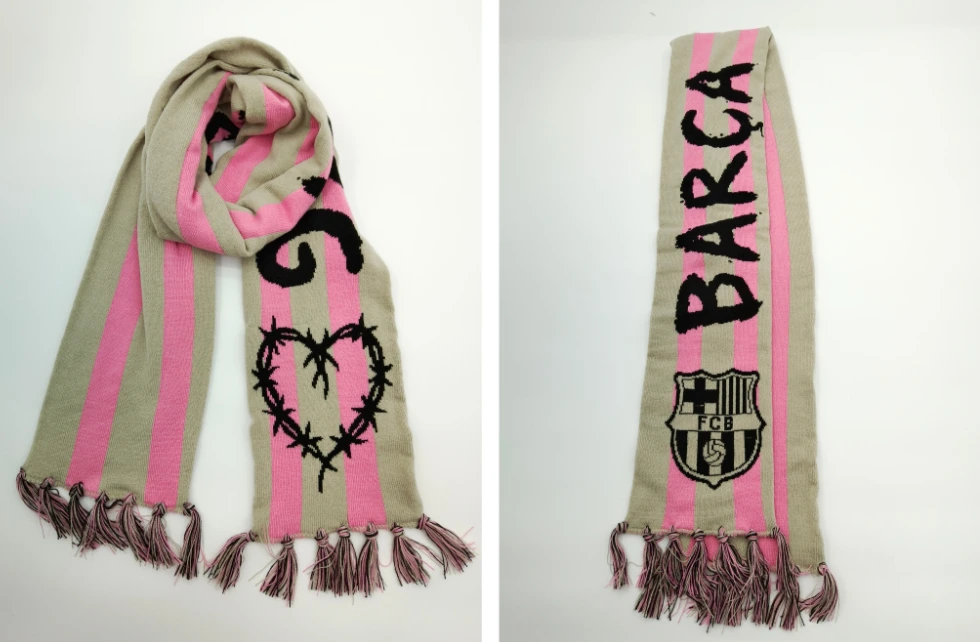
All-over pattern weaving on shuttle or rapier looms integrating brand logos, geometric repeat patterns and woven border designs directly into the fabric structure — no embroidery or print required. Minimum motif area 5cm × 5cm. Colour accuracy to Pantone TPX/TPG confirmed at lab dip sign-off before bulk production.
Suitable for corporate gifting, premium brand channel private label and sports club scarves requiring pattern complexity. Standard woven dimensions 30×180cm; custom sizes available on request. Fringe options: hand-knotted, machine-twisted, or hemmed.
Lead time: 30–45 days
MOQ 500 pcs
Plain & Twill Woven Merino
Classic woven constructions including plain weave, 2/2 twill, herringbone and houndstooth in 100% merino or merino-blend yarns. Produces a flatter, denser handle than knitted merino, typically finished with hand-knotted or machine-twisted fringe for a heritage aesthetic. Fastest lead time across the woven range at 25–35 days from PP sample sign-off.
Ideal for solid-colour programmes, seasonal colour refreshes and entry-level tier construction within a multi-SKU range strategy. Weight range 160–260 gsm. Yarn counts 2/28Nm and 2/48Nm standard; custom counts available.
Lead time: 25–35 days
MOQ 500 pcs
Knitted Merino — Gauge 7–14gg
Flat-bed knitting on gauge 7gg through 14gg machines, accommodating 2-ply through 4-ply merino yarn. Available textures include 1×1 rib, 2×2 rib, cable, waffle, moss stitch and tuck-stitch. Fine-gauge 14gg produces a lightweight travel-weight scarf (approx. 120–180g per piece); chunky 7gg delivers a substantial winter knit (200–340g).
The preferred construction for outdoor brand channel, travel accessories and lifestyle brands targeting the active consumer. Integrated woven label and machine-washable superwash grade available as standard specification options.
Lead time: 30–40 days
7–14gg
MOQ 500 pcs
Full Specification Reference — Merino Wool Scarves
Complete technical parameters for buyer specification sheets, supplier audits and quality control documentation.
500 pcs
MOQ / colour / style
17.5–19.5μm
Standard fibre grade
≤5% >30μm
Comfort factor standard
Grade 4
ISO 105-C06 wash fastness
| Specification | Detail |
|---|---|
| MOQ | 500 pcs per colour per style — applies to all blends and constructions |
| Sample Lead Time | 12–18 days from spec approval; salesman sample (SMS) within 7 days if reference available |
| Bulk Lead Time | 25–35 days (plain/twill woven); 30–45 days (jacquard woven); 30–40 days (knitted) |
| Fibre Grade | Fine merino 17.5–19.5μm (standard); superfine ≤17.5μm available on request at 15–25% premium |
| Comfort Factor | ≤5% of fibres exceeding 30μm — confirmed per batch per CSIRO / IWTO specification |
| Blend Options | 100% merino; merino-nylon 80/20 or 70/30; merino-cashmere 70/30 or 50/50 |
| Yarn Counts | 2/28Nm & 2/48Nm (woven); 2/16Nm (chunky knit 7gg); custom counts available |
| Weight Range | 160–280 gsm woven; 120–340 gsm knitted (by gauge and ply) |
| Constructions | Jacquard woven, plain/twill/herringbone, rib knit, cable knit, waffle knit (7–14gg) |
| Colour System | Pantone TPX / TPG; lab dip approval required before bulk dyeing; Delta-E ≤1.0 tolerance |
| Wash Fastness | ISO 105-C06 Grade 4 minimum; dimensional stability ≤3% shrinkage at 30°C |
| Certifications | OEKO-TEX Standard 100; AWTA fibre test report per batch; mulesing-free documentation available |
6-Step OEM Production Process — Merino Wool Scarves
From technical brief to bulk delivery. Each step generates documentation transferable to your compliance and QC records.
01
Fibre Specification & AWTA Confirmation
Micron range, comfort factor, blend ratio and mulesing-free status are locked at brief stage. AWTA test report for the sourced fibre lot is issued before yarn spinning commences — not estimated from finished fabric. Superfine upgrade and mulesing-free documentation paths are confirmed here before any cost is incurred downstream.
02
Yarn Specification & Colour Lab Dip
Yarn count, twist direction and ply are specified per construction (2/28Nm or 2/48Nm woven; 2/16Nm chunky knit). Pantone TPX/TPG colour reference submitted; lab dip produced within 5–7 days for buyer approval. Bulk dyeing does not commence until Delta-E ≤1.0 tolerance is confirmed in writing.
03
Strike-Off / Salesman Sample
Pre-production sample (PP sample) produced in confirmed fibre, yarn count, construction and colour. For jacquard woven, pattern accuracy on loom is confirmed at this stage. Knitted gauge and stitch structure are verified before tooling investment. Sample lead time 12–18 days from spec approval.
04
Bulk Production & In-Line QC
Bulk production commences on PP sample sign-off. In-line quality checks at three stages: yarn input (micron, twist), mid-production (fabric weight, colour), and finished-goods (dimensional, Martindale pilling at ISO 12945-2). Wash fastness and dimensional stability tested per ISO 105-C06 at finished-goods stage.
05
Finishing & Packaging
Available finishing options: anti-pilling enzyme treatment, superwash (machine-washable) processing, fringe knotting (hand or machine), brushing, and light pressing. Packaging from polybag (standard) through gift box with custom woven label, branded hang tag and OEKO-TEX article certificate — all from 500 pcs MOQ.
06
AQL 2.5 Final Inspection & Shipping
AQL 2.5 final inspection completed before goods leave factory. QC report — including colour measurement, fibre content, dimensional, wash fastness and pilling results — provided with every shipment. OEKO-TEX article certificate and AWTA test report issued per production lot. Third-party inspection (SGS, Bureau Veritas, Intertek) facilitated on request.
Who Sources Merino Wool Scarves from WeaveEssence
Fashion & Department premium channel Buyers
Mid-to-Premium Private Label at Volume
Buyers building own-label accessories ranges for fashion channels or premium brand programmes specify merino as the mid-tier anchor — above standard wool, below cashmere — delivering the highest volume at premium margin. Merino-nylon 80/20 suits everyday-wear SKUs; 100% merino targets gifting and heritage positioning. WeaveEssence produces both from 500 pcs MOQ within the same seasonal programme, simplifying vendor management across a tiered range.
Corporate Gifting & ESG Procurement
Natural Fibre Credentials for Compliance Programmes
Corporate buyers sourcing premium branded gifts for client or employee programmes specify merino for the combination of luxury positioning, functional performance claims, and verifiable natural-fibre credentials. OEKO-TEX Standard 100 certification and AWTA fibre test reports provide the documentation chain required by ESG-conscious procurement policies. Jacquard woven programmes deliver in-fabric logo without embroidery, maintaining a premium finish consistent with luxury gifting standards.
Outdoor & Travel brand channel Brands
Functional Performance Story for Active Consumers
Outdoor and travel brands source merino for its testable functional claims — moisture management, temperature regulation, odour resistance and UPF 15–25 — that create genuine product differentiation against synthetic alternatives. Knitted 7–14gg constructions in merino-nylon 70/30 are the most common specification: nylon adds durability for repeated use, merino retains the natural-fibre story that justifies premium price. Superwash machine-washable grade available to simplify care labelling.
B2B Importers & Wholesale Distributors
Consistent Fibre Specification Across Multi-SKU Orders
Importers managing multi-brand or multi-market distribution programmes require consistent fibre specification, colour accuracy and documentation across SKUs from different production runs. WeaveEssence issues AWTA test reports and colour measurement data per batch, enabling buyers to provide end-customers with verifiable fibre credentials for each SKU. Merino-cashmere 70/30 and 50/50 blends are frequently specified for premium catalogue items where “contains cashmere” labelling supports higher list prices without the cost of pure cashmere.
Why B2B Buyers Specify WeaveEssence for Merino Wool Programmes
AWTA Fibre Test Report Issued Before Yarn Spinning Begins
Mean fibre diameter and comfort factor are confirmed at raw fibre stage via Australian Wool Testing Authority test reports — not estimated from finished fabric. This eliminates the risk of specification drift between contract and production and gives buyers auditable fibre documentation at the earliest possible stage in the supply chain. AWTA reports are provided per batch as standard, not on request only.
Martindale Pilling Data Available for Every Construction
WeaveEssence provides ISO 12945-2 Martindale pilling test certificates for every merino construction — woven and knitted — as standard pre-production documentation. Buyers receive Grade and cycle count data before PP sample sign-off, enabling accurate claim-making at point of sale and compliance with importer supplier standards. Anti-pilling enzyme treatment to 5,000+ cycles available on request at brief stage.
Mulesing-Free Chain-of-Custody from Clip to Finished Article
For programmes where animal welfare credentials are commercially relevant — Nordic brand channel, UK department stores, ESG corporate gifting — WeaveEssence provides full mulesing-free chain-of-custody documentation from clip to yarn for Australian merino lots. New Zealand merino is specified for programmes where mulesing-free status must be inherent rather than certified, eliminating documentation risk entirely for the most demanding compliance requirements.
Frequently Asked Questions — Merino Wool Scarf Sourcing
What micron range is WeaveEssence merino wool?
17.5–19.5μm mean diameter, confirmed per batch by AWTA test report before yarn spinning begins. Comfort factor ≤5% fibres exceeding 30μm — the CSIRO/IWTO standard for next-to-skin wearability. Superfine lots at ≤17.5μm available on request at a 15–25% fibre premium.
What is the MOQ for custom merino wool scarves?
500 pcs per colour per style, applying equally to 100% merino, merino-nylon and merino-cashmere blends across woven and knitted constructions. Each colourway in a multi-SKU programme requires its own 500-piece minimum — mixed-colour orders cannot be combined to meet a single threshold.
Is WeaveEssence merino mulesing-free?
Mulesing-free certification is available for Australian merino lots on request, with chain-of-custody documentation from clip to yarn. New Zealand merino is inherently mulesing-free — no separate certification is required, making it the default specification for programmes with strict animal welfare compliance requirements.
What constructions are available for merino wool scarves?
Jacquard woven (30–45 days), plain and twill woven including herringbone (25–35 days), and knitted gauge 7–14gg covering rib, cable, waffle and tuck-stitch (30–40 days). All constructions share the 500 pcs MOQ per colour with consistent fibre sourcing across SKUs.
How does merino-cashmere blend compare to pure cashmere for wholesale buyers?
Merino-cashmere blends (70/30 or 50/50) brand channel at 25–35% below pure cashmere at comparable weight and construction while carrying “contains cashmere” fibre labelling — the key differentiator for premium gift and premium private-label programmes where cashmere on the hangtag is commercially significant. WeaveEssence supplies side-by-side sample sets of merino, merino-cashmere blend, and pure cashmere at the same construction and weight to support internal ranging and pricing decisions before production commitment.
Related Products & Services
Source Merino Wool Scarves from WeaveEssence — 500 pcs MOQ
17.5–19.5μm fine merino confirmed by AWTA batch report. 100% merino, merino-nylon and merino-cashmere blends. Jacquard woven, plain woven and knitted 7–14gg from one factory. OEKO-TEX Standard 100 certified. Sample lead time 12–18 days from spec approval.
- 500 pcs MOQ — 30–45 day bulk lead time
- 17.5–19.5μm fine merino — AWTA test report per batch
- Comfort factor ≤5% fibres >30μm — confirmed per lot
- Merino-nylon 80/20 or 70/30 for durability programmes
- Merino-cashmere 70/30 or 50/50 — “contains cashmere” label
- Mulesing-free chain-of-custody documentation available
- OEKO-TEX Standard 100 certified factory
- AQL 2.5 inspection — QC report with every shipment