Phone/whatsapp:+86177-2151-9382
Physical address:
Yangshanfan Road Intersection, Chengdong Village, Hengcun Town, Tonglu County, Hangzhou City, Zhejiang. China
Email address:
Quote@weaveessence.com
Cashmere Scarf Manufacturer China – OEM Cashmere Scarves
Cashmere Scarf Manufacturer for OEM Private Label Production
Grade A cashmere 14.5–15.5 µm, IWTO-12 verified per lot. Three blend options, jacquard and plain weave, 500 pcs MOQ. OEKO-TEX Standard 100 certified.

500 pcs
MOQ per Colour
14.5–15.5 µm
Grade A Fibre Diameter
35–50 days
Bulk Lead Time
OEKO-TEX
Standard 100 Certified
IWTO-12
Fibre Diameter Verified
Why Cashmere Scarves Command Premium B2B Margins
Understanding what separates Grade A cashmere from commodity fibre — and how factory-direct sourcing captures the margin difference.
Cashmere scarves occupy a distinct tier in the accessory market because the fibre itself is both genuinely scarce and measurably superior to alternatives. True Grade A cashmere is defined by a mean fibre diameter of 14.5–15.5 microns and a staple length not exceeding 52 mm — specifications that place it below the sensory threshold at which most human skin detects itchiness (commonly cited at 18–20 microns). At this diameter, cashmere provides warmth-to-weight performance that merino wool, even at its finest 17.5-micron grade, cannot replicate. This physical advantage is not marketing language — it is why cashmere scarves sell through B2B channels at 3–5 times the price of equivalent merino styles with minimal price elasticity resistance when the positioning is clear.
Factory-direct sourcing from a verified Chinese manufacturer compresses the supply chain between Inner Mongolia raw fibre and your warehouse to the minimum number of steps. WeaveEssence operates with direct relationships at the fibre and yarn stage, meaning price transparency extends to the raw material. Buyers sourcing cashmere through agents or trading companies typically absorb 15–25% in trading-company margin on top of factory cost; custom scarf OEM sourcing direct from the factory eliminates that layer entirely. Combined with a 500-piece MOQ that makes genuine Grade A cashmere accessible to brands at early growth stages, factory-direct cashmere sourcing creates a structural margin advantage that compounds across seasons. For buyers building a winter scarves range, the combination of Grade A fibre and direct factory access represents the most defensible margin position available in the category.
Common Misconception
“All cashmere scarves are the same quality — it’s just a fibre name.”
Reality: Cashmere quality varies across three graded tiers. Grade A is defined by ≤15.5 µm mean diameter and ≤52 mm staple length, both measured to IWTO-12 standard. Grade B typically measures 16–17 µm with shorter, broken fibres from secondary combing passes, producing measurably higher pilling rates — ISO 12945-2 tests routinely show a 1–1.5 grade drop between Grade A and Grade B scarves at 2,000 Martindale cycles. Grade C fibre, sometimes blended with wool without disclosure, may test above 18 µm — at which point the fibre is no longer technically cashmere by IWTO definition.
Buyers can verify supplier claims by requesting the IWTO-12 mean fibre diameter test report for each lot — any reputable Grade A supplier can produce this within 48 hours. Secondary verification via SEM (scanning electron microscopy) fibre composition report confirms cashmere fibres are present at the claimed percentage. A supplier unable or unwilling to provide either document is not supplying verified Grade A cashmere, regardless of what the invoice states.
Cashmere Blend Options
Three fibre compositions to match your positioning, price point and performance requirements — all using Grade A cashmere as the primary component.
Pure Luxury
100% Grade A Cashmere
The definitive luxury specification: 100% Grade A cashmere at 14.5–15.5 µm, no blending agents. Delivers maximum softness and warmth-to-weight performance achievable with natural fibre — correct for luxury brand channel, premium gifting, and any brand where the cashmere story is central to the value proposition.
14.5–15.5 µm
120–180 gsm woven
150–220 gsm knitted
IWTO-12 cert
Lustre & Drape
Cashmere-Silk — 70/30
70% cashmere / 30% mulberry silk combines thermal softness with natural lustre and drape. The silk component reduces finished weight to 100–140 gsm — lighter than pure cashmere at the same warmth level — and produces a subtle sheen particularly effective in solid jewel tones. Preferred for SS collections and fashion-forward premium positioning.
70/30 ratio
100–140 gsm
Mulberry silk
OEKO-TEX
Price-Performance
Cashmere-Merino — 50/50 or 70/30
Available in 50/50 or 70/30 cashmere-to-merino ratios (17.5-µm fine merino). The merino adds structural resilience and significantly improves pilling resistance versus 100% cashmere, while maintaining a luxury handle that clearly differentiates from pure merino. The 70/30 ratio typically retails at 40–55% of 100% cashmere equivalent — a meaningful step-price option within a cashmere family range.
50/50 or 70/30
150–220 gsm
17.5 µm merino
SEM verified
Construction & Weave Types
Three primary construction methods — each with distinct aesthetic and technical characteristics suited to different market positions.
Pattern-Intensive
Jacquard Cashmere
Produced on electronic jacquard looms capable of all-over pattern repeat in up to 8 colours per pick. The highest-value proposition for buyers building brand identity into the fabric itself. Minimum logo or pattern area 5 cm × 5 cm at standard gauge; tighter repeats available at 12gg and above. Particularly effective in the cashmere-silk blend, where silk enhances pattern contrast. Technical design files accepted in vector format; Pantone-to-yarn conversion included in the 10–15-day sample lead time.
Heritage Tailoring
Plain Weave Cashmere
Woven on shuttle looms in a balanced plain weave structure, producing a flat, dense handle associated with classic luxury positioning. Typically finishes at 120–160 gsm in cashmere-silk 70/30 and 140–200 gsm in 100% cashmere — most appropriate for spring-summer collections where lightweight warmth and refined drape are primary requirements. Standard sizes 180 × 65 cm and 70 × 70 cm square. Hand-knotted fringe, machine fringe and hand-rolled hems all available. Easiest construction to colour-match to Pantone standards due to uniform dye uptake of woven structure.
7–12 gauge
Knitted Cashmere — 2-ply & 3-ply
Produced on flat-bed knitting machines across 7gg to 12gg gauge range. A 2-ply 12gg construction delivers a fine, smooth fabric for slim scarves and lightweight wraps; a 3-ply 7gg construction produces the heavier textured handle associated with luxury winter gifting and chunky-knit fashion positioning. Rib, cable, moss stitch and tuck stitch structures all available alongside plain jersey. 100% Grade A cashmere at 2-ply 12gg typically finishes at 155–175 gsm — the most commonly ordered specification for premium fashion brand AW range building. Cashmere-merino blend particularly recommended for buyers prioritising pilling durability in knitted formats.
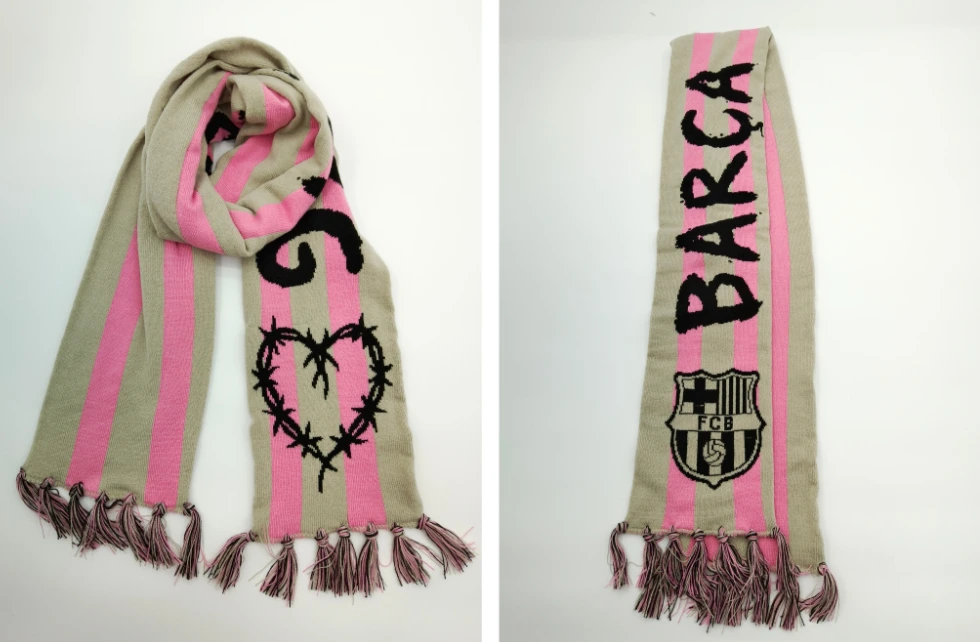
Jacquard Cashmere — Up to 8 colours per pick
Plain Weave — 120–200 gsm, solid & heather

Knitted Cashmere — 7–12gg, rib & cable available
Production Capability at a Glance
Key commercial parameters for WeaveEssence cashmere scarf production.
500 pcs
MOQ per colour/style
14.5–15.5 µm
Grade A fibre diameter
≤52 mm
Staple length (Grade A)
Grade 3+
Martindale pilling pass
Cashmere Scarf Specifications
Full technical specification reference for WeaveEssence cashmere scarf production.
| Specification | Detail |
|---|---|
| MOQ | 500 pcs per colour per style — all constructions and blend options |
| Lead Time | Samples: 10–15 working days from spec approval. Bulk: 35–50 days from PP sample sign-off |
| Fibre Grade | Grade A — Inner Mongolia / Mongolia sourced, IWTO-12 verified per lot |
| Micron Range | 14.5–15.5 µm mean diameter; coefficient of variation ≤24% (OFDA histogram) |
| Staple Length | ≤52 mm (Grade A definition); longer staple lots rejected at intake |
| Weight Range | 100–140 gsm (cashmere-silk woven); 120–200 gsm (100% cashmere woven); 150–250 gsm (knitted) |
| Constructions | Jacquard weave, plain weave, 2-ply knit 7–12gg, 3-ply knit 7–10gg, rib, cable, moss stitch |
| Blend Options | 100% cashmere; cashmere-silk 70/30; cashmere-merino 70/30 or 50/50 |
| Colour System | Pantone TPX/TPG; spectrophotometer verified ΔE ≤1.5 (solid); ΔE ≤2.0 (yarn-dyed jacquard) |
| Pilling Standard | ISO 12945-2 Martindale ≥3,000 cycles Grade 3 min (100% cashmere); Grade 3–4 (cashmere-merino) |
| Colour Fastness | ISO 105-C06 Grade 4 min (washing); ISO 105-X12 wet and dry rub assessment |
| Certifications | OEKO-TEX Standard 100; IWTO-12 fibre diameter report; SEM composition certificate per lot |
| Finish Options | Hand-knotted fringe, machine fringe, hand-rolled hem, overlock edge, fringed tassel |
| Packaging | Polybag with hang tag; gift box; custom tissue wrap; flat fold or roll — buyer specified |
Cashmere OEM Process — From Fibre Brief to Shipment
Six-step workflow designed for B2B buyers commissioning Grade A cashmere scarves for the first time or scaling an existing programme.
01
Day 1–2
Specification & Fibre Brief
Buyer submits blend option, construction type, weight target, colourway brief (Pantone TPX/TPG or physical swatch), finish requirements and quantity. WeaveEssence returns a technical specification sheet and pricing confirmation within one working day.
02
Day 2–5
Fibre Lot Selection & IWTO-12 Verification
Specific fibre lot selected from Grade A stock. IWTO-12 mean diameter report and OFDA fibre histogram reviewed; lots with CV above 24% are rejected. SEM fibre composition test conducted at yarn stage before any production commitment. Documentation sent to buyer for approval.
03
Day 5–12
Lab Dip & Colour Development
Cashmere lab dips developed against buyer-approved Pantone reference. Typically 2–3 strike rounds required due to cashmere’s distinctive dye absorption characteristics versus wool or synthetics. Spectrophotometer verification to ΔE ≤1.5 (solid) before approval. Physical lab dip cards sent to buyer.
04
Day 10–15
Pre-Production Sample
1–3 finished scarves produced in buyer’s specified construction and colourway. Martindale pilling test and colour fastness (ISO 105-C06) conducted on sample fabric before shipping. Full documentation package (IWTO-12, SEM, pilling report, OEKO-TEX certificate) included with physical sample package.
05
Day 15–45
Bulk Production & AQL Inspection
Bulk production commences upon signed PP sample approval. In-line quality monitoring: fibre lot traceability maintained; AQL 2.5 inspection at finishing stage. Spectrophotometer colour check against approved standard on every dye batch. Dimensional conformance checked against approved sample measurements.
06
Day 45–50
Final Inspection & Shipment
Pre-shipment inspection available for buyer-appointed third-party inspector (SGS, Intertek, or buyer-nominated agent). Full documentation package compiled and sent electronically before goods leave factory. Shipping options include sea freight LCL/FCL, air freight, and express courier for smaller development orders.
Who Sources Cashmere Scarves from WeaveEssence
The buyer profiles that most commonly engage WeaveEssence for Grade A cashmere scarf production.
Luxury brand channel Buyer
Premium Fashion & Department premium channel Buyers
Buyers for premium fashion brands and premium own-label programmes sourcing 100% Grade A cashmere for core AW range building. Primary requirements: verified fibre documentation, Pantone colour accuracy, and consistent lot-to-lot quality. IWTO-12 and SEM documentation enables cashmere grade claims in product labelling across EU and UK regulated brand channels.
Private Label Developer
Private Label Brand Founders
Brand founders launching or scaling a cashmere accessory line with 500-piece MOQ entry point. Factory-direct pricing eliminates the 15–25% trading-company margin absorbed through agents or trading companies. Cashmere-merino 70/30 blend provides a step-price option for a two-tier range structure, with the cashmere-merino style typically retailing at 40–55% of the 100% cashmere equivalent.
Gifting & Corporate
Premium Corporate & Gifting Sourcing Teams
Procurement teams sourcing cashmere scarves for executive gifting, loyalty programmes and premium brand merchandise. Requirements: consistent quality across multi-colour orders, reliable lead time, and gift packaging options (gift box, tissue wrap, ribbon). OEKO-TEX Standard 100 certification satisfies corporate sustainability due diligence requirements without additional audit cost.
Wholesale Distributor
Wholesale & Multi-Brand Distributors
Wholesale buyers supplying cashmere scarves to independent boutiques, multi-brand distributors and e-commerce platforms across European and North American markets. Require breadth across blend options and constructions from a single supplier, with consistent lead time performance for seasonal programme planning. SEM blend verification documentation supports brand buyer requirements for composition accuracy on product labels.
Verification & Quality Assurance
Documentation-backed quality claims — not marketing language.
Five Documents — Standard Issue
Every cashmere shipment from WeaveEssence is accompanied by five documents as standard: IWTO-12 fibre diameter test report, SEM fibre composition certificate, ISO 12945-2 pilling test report, ISO 105-C06 colour fastness report, and OEKO-TEX Standard 100 certificate with current validity date. No request required — documentation ships with goods.
48-Hour Document Response
For buyers auditing an existing production style or verifying claims before order commitment, all five standard documents are available within 48 hours of request for any active WeaveEssence specification. New development styles receive full documentation with the pre-production sample, delivered alongside the physical sample package before bulk production begins.
Pre-Shipment Inspection Welcomed
Third-party pre-shipment inspection by SGS, Intertek, or any buyer-appointed inspector is welcomed at our facility and can be specified at purchase order stage — no additional fee from WeaveEssence for facility access. Third-party testing costs are at buyer’s cost and built into the production schedule so they do not extend the confirmed ship date.
Cashmere Buyer Fit
How to Brief a Cashmere Scarf Manufacturer Before Sampling
Cashmere scarf projects need clearer specifications than ordinary winter scarves. Before quoting or sampling, the buyer and factory should align on fiber direction, blend ratio, yarn count, gauge, size, weight, handfeel, label claim, MOQ and packaging standard. This helps prevent a quote that looks attractive but does not match the intended product tier.
Cashmere scarf specification checkpoints
| Buyer Decision | What to Confirm | Why It Changes the Quote |
|---|---|---|
| Fiber claim | 100% cashmere, cashmere wool blend, cashmere silk blend, or premium wool alternative. | Fiber content affects raw material cost, label wording, testing scope and target retail positioning. |
| Yarn and construction | Yarn count, ply, gauge, knit structure, woven structure, fringe or edge finish. | Controls weight, warmth, drape, sampling time and production capacity. |
| Handfeel target | Reference sample, softness expectation, brushing or washing direction, pilling tolerance. | Finishing choices can improve softness but may affect shedding, pilling and dimensional stability. |
| Private label pack | Main label, care label, hang tag, barcode, folded size, box or polybag, carton mark. | Premium cashmere buyers often need packaging approval before bulk packing begins. |
Cost Drivers
What Affects Cashmere Scarf Manufacturing Cost?
SERP questions around cashmere pricing show that buyers compare both retail value and manufacturing cost. For B2B sourcing, the important point is not a single public price; it is the specification behind the quote.
- Fiber content and grade: pure cashmere and blend programs should be quoted separately.
- Yarn color and MOQ: custom dye colors can change minimums and lead time.
- Size and finished weight: larger scarves and heavier gauges use more yarn and machine time.
- Construction: knit, woven, jacquard, fringe, brushing and edge finishing require different workflows.
- Private label requirements: labels, tags, barcode, gift box and carton standards should be costed as a separate line.
- Compliance and documentation: fiber content testing, care label rules and market-specific documents must be checked before order confirmation.
Internal planning links for cashmere scarf buyers
Private Label Scarf Manufacturing
Plan labels, hang tags, packaging and SKU control for premium scarf programs.
Natural Fiber Properties
Compare cashmere, wool, cotton and silk behavior before selecting material claims.
Blended Yarns Guide
Use blend ratio planning when pure cashmere is not the right cost or performance fit.
Request a Cashmere Scarf Quote
Send quantity, material direction, size, branding and timing to reduce quote assumptions.
FAQ Support
Cashmere Scarf Manufacturer Questions to Answer on the Page
How much should a 100% cashmere scarf cost?
Answer with a sourcing lens: cost depends on fiber grade, weight, construction, finish, MOQ, packaging and testing. Avoid giving a universal number without specifications.
Can cashmere scarves be private labeled?
Yes, when label files, care content, hang tags, barcode, packaging and carton marks are approved before bulk packing.
What should buyers send for a cashmere scarf quote?
Send material direction, blend ratio if known, finished size, target weight, quantity by SKU, color references, packaging files and market compliance expectations.
Ranking Protection
OEM Cashmere Scarf Quote Controls for Premium Buyers
OEM cashmere scarf searches already show strong ranking potential. To protect that visibility, the page should answer the buyer’s next question clearly: what information is needed before the factory can quote a cashmere scarf that matches the intended material tier, handfeel, label claim and retail presentation?
| Quote Control | Buyer Should Send | Why It Protects the Order |
|---|---|---|
| Material claim | 100% cashmere, cashmere wool blend, cashmere silk blend or target price tier. | Prevents the quote from mixing different fiber claims and retail promises. |
| Finished weight | Size, GSM or target grams per piece, gauge, ply and reference sample if available. | Controls warmth, drape, yarn consumption, carton weight and cost. |
| Private label pack | Main label, care label, hang tag, barcode, folded size, box or polybag and carton marks. | Premium cashmere buyers usually need a packed-unit approval before cartons are sealed. |
| Pilling and handfeel | Softness target, brushing direction, pilling tolerance and washing or finishing expectations. | Keeps premium handfeel decisions connected to durability and sample approval. |
Internal Links
Related Paths for Cashmere Scarf Buyers
Cashmere buyers often need private label, OEM and material comparison guidance before they are ready to request a quote. These links keep the premium-material path connected to the commercial pages.
Private Label Scarf
Use this page when cashmere scarves need labels, hang tags, barcode, gift box or retail packing.
OEM Scarf Manufacturing
Use this page when the buyer needs custom size, artwork, material, label and packaging development.
Scarf Materials
Compare cashmere with wool, silk, cotton, polyester, acrylic and recycled yarn options.
Request an OEM Cashmere Scarf Quote
Send material claim, size, target weight, quantity, label files, packaging and destination market.
GSC Buyer Signal
Cashmere Scarf Manufacturers in China: OEM Buyer Checklist
Buyers comparing cashmere scarf manufacturers in China usually need more than a product photo. They need fiber-grade clarity, blend options, sampling control, MOQ logic, labeling, packaging, and export-ready documentation before they can approve an OEM cashmere scarf program.
OEM cashmere scarf scopeConfirm pure cashmere, cashmere blend, wool-cashmere blend, gauge, weight, hand feel, color standards, and private label requirements.
Cost and grade factorsUnit price changes with fiber grade, yarn count, scarf size, knit or weave construction, finishing, packaging, test requirements, and order quantity.
China manufacturer proofAsk for sample timeline, material certificate options, color control, label and hang tag handling, packing plan, and final inspection workflow.
Frequently Asked Questions
Technical and commercial questions buyers ask most when sourcing cashmere scarves from WeaveEssence.
What cashmere grade do you use?
Grade A cashmere from Inner Mongolia and Mongolia, mean fibre diameter 14.5–15.5 µm and staple length ≤52 mm — both verified to IWTO-12 per lot. Fibre composition is confirmed at yarn stage via SEM before production begins.
What is the MOQ for custom cashmere scarves?
500 pcs per colour per style across all constructions and blend ratios — set by dye-lot consistency requirements (batches below this volume exceed our ΔE ≤1.0 tolerance). Development samples (1–3 pcs) are available within 10–15 days of spec approval.
How do you prevent pilling in cashmere scarves?
Pilling is controlled at spec stage: Grade A fibre (≤15.5 µm, ≤52 mm staple) combined with minimum 2/26Nm yarn twist reduces surface fibre migration. All finished scarves pass ISO 12945-2 Martindale at ≥3,000 cycles Grade 3 min (100% cashmere) or Grade 3–4 (cashmere-merino).
Can you match specific Pantone colours in cashmere?
Yes — Pantone TPX/TPG matched to ΔE ≤1.5 (solid) and ΔE ≤2.0 (yarn-dyed jacquard), verified by spectrophotometer. Cashmere lab dips typically require 2–3 strike rounds, built into the 10–15-day sample lead time.
What certifications apply to cashmere scarves?
Standard documentation per shipment: OEKO-TEX Standard 100, IWTO-12 fibre diameter report, and SEM fibre composition certificate — enabling Grade A cashmere claims in EU and UK regulated brand channel labelling. Third-party testing via SGS or Intertek is available on request; GRS does not apply to virgin cashmere but is available on our recycled-yarn scarves range.
Related Pages
Explore related materials, construction types and sourcing solutions from WeaveEssence.
Ready to Source Premium Cashmere Scarves?
Send us your specification — blend option, construction, quantity and colourway brief — and we return pricing, lead time and a sample proposal within one working day.
- 500 pcs MOQ — Grade A cashmere accessible at growth-stage volumes
- IWTO-12 + SEM + OEKO-TEX documentation standard with every order
- Free pre-production samples — quality confirmed before bulk commitment
- 35–50 day bulk lead time from PP sample sign-off
- Pre-shipment inspection by buyer-appointed inspector welcomed
- Factory-direct pricing — no trading-company margin layer